
Viktoriia Kharchenko,
Head of Marketing Department
Table of Contents
“Auditors come looking for mistakes”
That is exactly how many companies perceive an audit.
Because of this, preparation is delayed until the very last minute, problematic areas are swept under the rug, or teams attempt to “clean up” documents just days before the audit begins.
However, this is the wrong approach.
A good audit is not about “catching” a company making an error.
Its real value lies elsewhere.
If an auditor identifies a risk several months before year-end, the business still has time to resolve it.
If that same risk is uncovered by tax authorities during an inspection, it often translates into penalties, tax reassessments, and unnecessary financial losses.
That is why preparing for a statutory audit begins long before your first meeting with the auditor.
Let’s examine the mistakes businesses make most frequently.
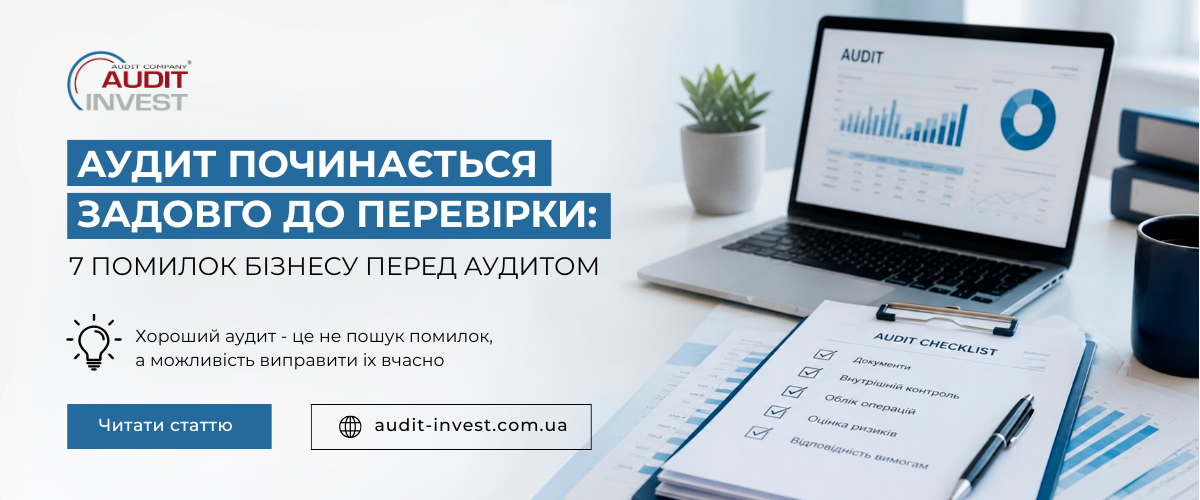
7 Mistakes Businesses Make Before a Statutory Audit
Mistake #1. Starting preparation only a few weeks before the auditThis is probably the most common mistake.
Many companies think:
“What’s there to gather? The documents exist. We’ll sort it out in a few days.”
In practice, reality looks quite different.
It turns out that some primary documents are missing, an inventory count must be conducted, contracts need locating, or written justifications are required for certain transactions.
All of this requires time.
When time runs out, the team is forced into constant firefighting mode.
That is why preparation for a statutory audit should begin well in advance.
Mistake #2. Skipping an internal review of documentationCompanies are often confident that their paperwork is in full order.
Until they actually start collecting it.
That is when they discover that:
- primary source documents are missing;
- some contracts are unsigned;
- acceptance certificates contain errors;
- certain records cannot be located at all.
The earlier this is uncovered, the easier it is to fix the situation.
Sometimes businesses hesitate to discuss disputed transactions or problem cases with the auditor.
The rationale seems simple:
“Better not draw attention to it.”
In reality, it works completely against you.
An audit is not an adversarial battle between a business and an auditor. It is a collaborative effort.
Returning to the metaphor from the previous article, an audit is a dance for two partners. On one side is the audit team analyzing risks and helping evaluate them. On the other side is the company, openly providing context and explaining operational specifics.
A good auditor does not arrive thinking: “Let me find something to nitpick.” They arrive thinking: “Let’s check if there is anything here that could become a problem for the business tomorrow.” Their goal is not to put the company on the spot, but to help pinpoint and eliminate risks while they can still be resolved without penalties, assessments, or unnecessary stress.
The smoother this collaboration, the greater the value the business derives from the audit.
Mistake #4. Assuming an audit is solely a check of numbersIf an auditor merely cross-checks figures in the financial statements, that does not mean the business has gained maximum value.
An audit evaluates much more than just financial metrics.
It also examines:
- the internal control system;
- the formal validity and accuracy of documents;
- high-risk transactions;
- specific business processes that could directly impact financial reporting.
Often, insights in these areas become the most significant takeaway for management.
Mistake #5. Underestimating the importance of primary documents
If a document is drafted improperly or missing entirely, even a completely legitimate transaction can trigger scrutiny during an inspection.
That is why it is essential to verify not just the numbers in reports, but the underlying documents supporting them.
Mistake #6. Failing to involve key team members
Auditors frequently require explanations from the CFO, legal counsel, HR, department heads, or project managers who handled specific contractual arrangements.
When the entire burden is placed solely on the accounting department, the process slows down and the risk of misunderstandings increases.
Mistake #7. Selecting an auditor based solely on priceWe explored this pitfall previously in the article “Not All Outsourcing Is Created Equal”.
In professional services, the lowest price rarely represents the best value.
A competent auditor is not merely someone who issues an audit report.
They are backed by an entire team that helps a business identify vulnerabilities long before they materialize into financial losses.
Therefore, when choosing an audit firm, look beyond cost alone: consider their experience, team, certifications, track record, expertise, and reputation.
Why a Quality Auditor Identifies Issues Before an Inspection
There is a widespread misconception that an audit is an exam. In truth, it is much closer to a comprehensive vehicle inspection before a long journey.
You could, of course, skip checking the car and hope for the best. Or you can find out in advance that the brake pads are worn and replace them before they fail on the highway. An audit follows the exact same logic. You do it for your own peace of mind.
A good auditor isn’t looking to fail a company. They help identify exposures when they can still be resolved without serious fallout. Sometimes it is a missing document, sometimes an accounting oversight, and sometimes a legacy process that has run unchecked for years despite no longer meeting statutory regulations.
That is why the value of an audit is measured not by the number of errors uncovered, but by the number of problems the business successfully avoided.
In Place of a Conclusion
A statutory audit is not a finish line; it is part of a company’s disciplined financial management.
The earlier a business begins preparation, the greater opportunity it has to address issues without rush, penalties, or unnecessary stress.
If your company is undergoing a statutory audit this year, do not view the auditor as an inspector who has come to grade your work. View them as a partner who helps you see the broader picture and detect risks before they escalate into liabilities.
For over 20 years, the Audit Invest team has supported Ukrainian businesses through audits and knows firsthand that optimal outcomes happen when preparation starts early, built on trust and transparent dialogue between company and auditor.
If you want to complete your audit without rush, unnecessary worry, or unpleasant surprises, start preparing today. We are here to make this process clear, predictable, and seamless for you.