
Nataliia Ushkan,
Transfer Pricing Analyst
Table of Contents
On January 1, 2022, rules governing the taxation of profits of controlled foreign companies (CFCs) entered into force in Ukraine, codified in Article 39² of the Tax Code of Ukraine. Initial reports were submitted by CFC controlling persons in 2023 mostly on a formal basis. Today, however, CFC compliance scrutiny has intensified significantly, as tax authorities have begun to thoroughly analyze transactions with non-residents, where CFC rules closely intersect with transfer pricing.
CFC Report Dynamics
According to current State Tax Service data as of year-end 2025:
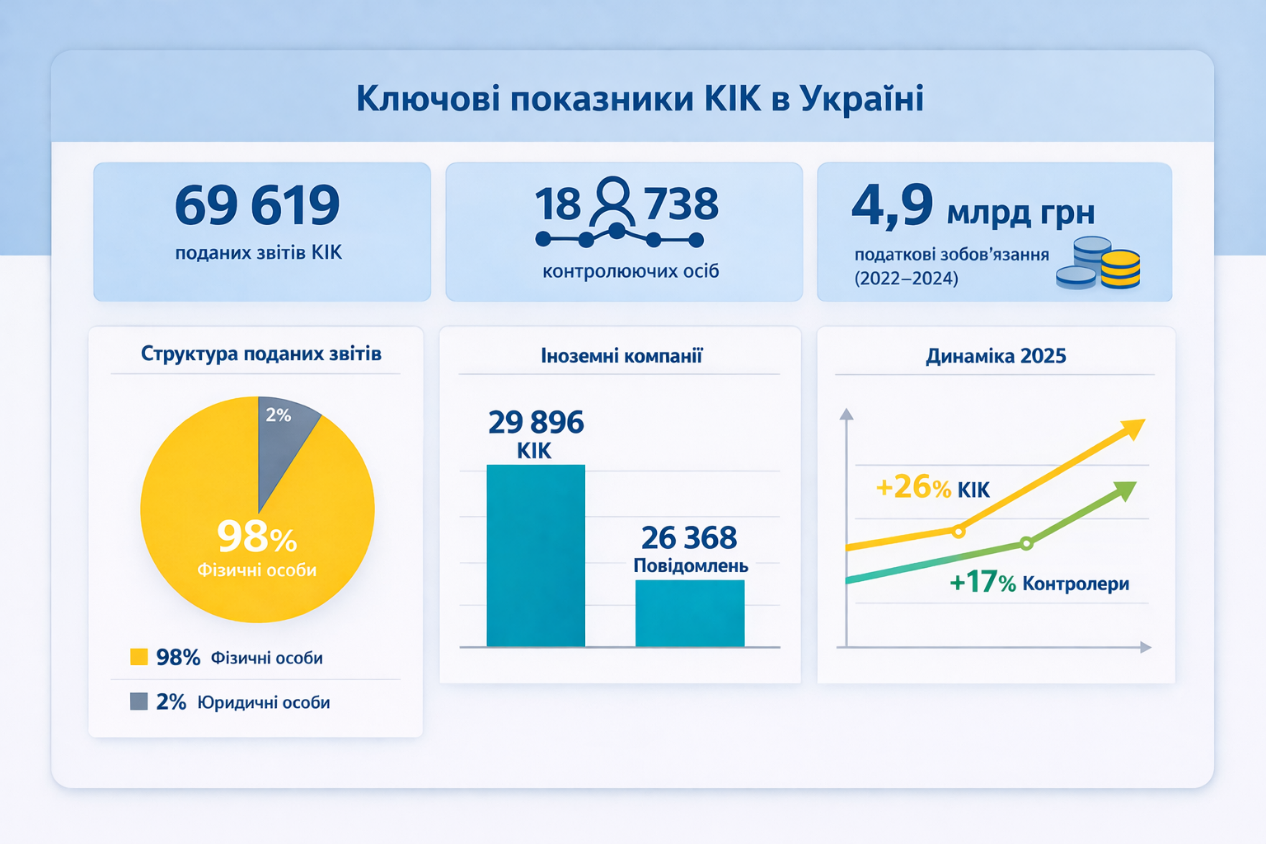
Statistical data demonstrates a massive scale: to date in Ukraine, there are officially identified
18,738 controlling persons who collectively own or control 29,896 foreign companies.
Tax liabilities assessed for payment by CFC controllers for 2022–2024 amount to UAH 4.9 billion, including UAH 2.9 billion for 2024 alone.
Analysis of the geographic breakdown reveals that Ukrainian controllers’ priorities are divided between traditional financial hubs and jurisdictions offering preferential tax regimes:
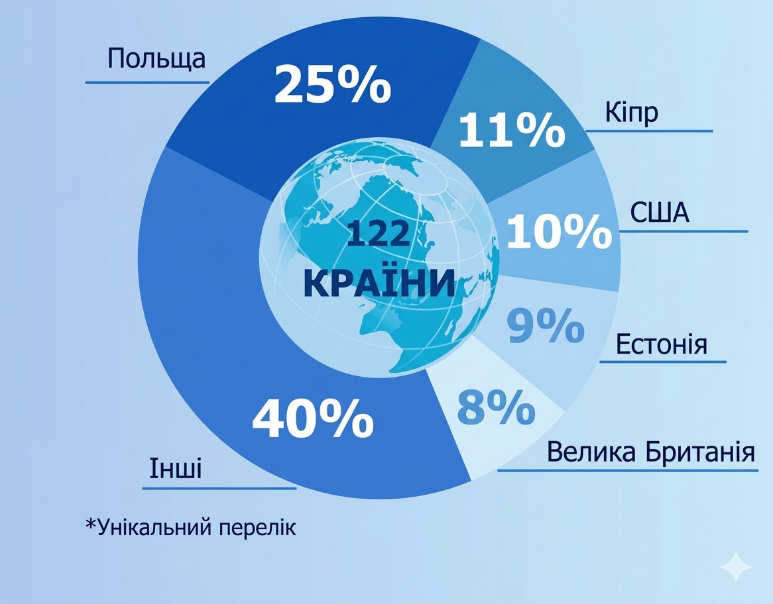
According to official STS data as of year-end 2025: the number of declared CFCs increased by 26%, and the number of controlling persons grew by 17%.
As of today, Ukrainian tax authorities have initiated systematic enforcement over CFCs, having received initial data packages under the Common Reporting Standard (CRS) automatic exchange (September 2024). While these records are currently partial and encompass a limited number of jurisdictions, their scope is steadily expanding, and full data consolidation is expected across 2025–2026.
The result: full-scale tax audits, formal requests for explanation, and initial tax reassessments.
How Does the STS Find CFCs?
The STS is shifting from selective audits to comprehensive automated screening. The volume of inquiries sent to foreign jurisdictions is growing, and with it, the exposure of undeclared CFCs.
The STS is expanding its intelligence gathering channels — meaning the outdated notion that “if a company is incorporated abroad, the STS won’t see it” no longer holds true.
Why CRS Has Changed the Rules of the Game
CRS (Common Reporting Standard) is the OECD standard for the automatic exchange of financial account information between jurisdictions. For CFC owners, this means one thing: banking secrecy is de facto abolished between Ukraine and more than 120 partner jurisdictions.
Ukraine has not merely joined CRS, but has implemented full-cycle information exchanges. It is crucial to recognize: this process is reciprocal — the State Tax Service of Ukraine also transmits financial records to foreign counterparts. The tax office now automatically receives account numbers, year-end balances, as well as gross dividends and interest credited to Ukrainian tax residents abroad. Any discrepancy between these records and a filed CFC report or CFC notification serves as an immediate audit trigger.
CRS Workflow — How Data Reaches the State Tax Service of Ukraine
Automatic annual flow of financial intelligence without taxpayer participation
CRS Operational Mechanism:
- Identification: When opening or updating an account at a foreign banking institution, you submit a passport or address documentation linked to Ukraine.
- Report compilation: The financial institution aggregates data regarding balances on your personal accounts and accounts of entities where you qualify as a UBO (Ultimate Beneficial Owner).
- Transmission: Once a year, the foreign jurisdiction’s tax authority transmits the dataset to the State Tax Service of Ukraine.
- Cross-matching: The automated STS system matches CRS datasets against your personal tax filings and CFC reports. Any discrepancy constitutes grounds for an automated inquiry.
Implications of Tax Information Exchange
Retrieved data forms the evidentiary groundwork for official inquiries to taxpayers or competent foreign authorities concerning specific operations, providing tax auditors with added justification to demand verification of the origins of overseas wealth and verify CFC compliance.
How Else Does the Tax Authority Identify CFCs?
Beyond CRS, additional enforcement channels include:
- Automated screening of European Ultimate Beneficial Owner (UBO) registries for immediate identification of real owners of foreign corporate vehicles.
- Cross-checking customs databases and transfer pricing documentation, uncovering undisclosed CFCs via international trade supply chains and signatures on foreign contracts.
- Advanced OSINT methods: Investigating open-source digital footprints (LinkedIn, corporate portals, trademark and IP registries).
- Reconciling cross-border banking transactions with asset declarations and anti-corruption investigative materials.
This multi-layered approach makes concealing a CFC virtually impossible, as any digital or documentary footprint gives tax auditors direct cause to assess statutory penalties.
STS Audit Priorities in 2026
Based on enforcement trends across 2024–2025, CFC tax audits are focused on several critical areas:
- Synchronization of CRS Data and CFC Reporting: The STS systematically leverages CRS datasets to reconcile foreign bank balances with CFC reports, verify accrued passive income, and flag unfiled CFCs.
- Completeness and Timeliness of CFC Reports: Auditors verify actual filing, adherence to deadlines, inclusion of underlying financial statements, and proper declaration in personal returns.
- Abuse of Tax Exemptions: Scrutiny covers exemptions claimed under the €2 million total revenue cap, effective tax rates of ≥13%, and active business tests. Special attention is directed at artificial corporate fragmentation.
- Economic Substance: Auditing for verified physical offices, dedicated payroll staff, operating expenditures, and actual conduct of commercial operations.
- Place of Effective Management: Evaluating where decisions are made, who exercises control over bank accounts, and who negotiates contracts. If management functions are carried out from Ukraine, the foreign entity risks being deemed a Ukrainian tax resident or a permanent establishment.
- Transfer Pricing Adjustments: Reviewing CFC functions, risks, and assets. Where an entity serves as a nominal intermediary, profits may be reallocated.
- Income Classification: Verifying the correct categorization of income into active and passive streams.
Particular emphasis is placed on de facto control. This means that even without legal shareholding, an individual may be deemed a controlling person if they exert real decisive influence over business operations, banking accounts, or executive resolutions. The burden of proving de facto control rests with the STS; however, taxpayers cannot remain passive: maintaining documentary evidence of the authentic governance structure is vital.
Checklist for the Controlling Person
To prepare for STS audits, we recommend reviewing the following checklist:
-
- Structure Inventory: Review all foreign entities in which you hold an interest. Identify the actual controlling person (under TCU criteria).
- Bank Account Reconciliation: Ensure that records reported to the tax service correspond directly with data in foreign bank KYC profiles.
- Exemption Assessment: Confirm whether legitimate grounds exist to exempt CFC profits from tax (e.g., applicable Double Taxation Treaties or income thresholds).
- Record Updates: Confirm whether any changes in ownership structure or management have occurred over the past year that have not yet been notified to the STS.
- Substance Verification: Maintain evidence supporting the economic reality of operations: lease agreements, payroll records, and board minutes.
- Documentation File: Prepare or update statutory financial statements of the foreign entity in compliance with international standards.
CFC compliance is not merely about tax forms; it involves international corporate structuring, financial transparency, and robust documentary backing. Errors carry high financial stakes, and resolving them post-factum is far more challenging than building a compliant approach from the start.
Our international tax practice provides full support at every stage — from initial diagnostics of your corporate structure to preparing complete documentation packages for supervisory authorities.
Audit Invest will help: screening of transactions with non-residents, Report on Controlled Transactions, and a complete transfer pricing documentation package.